




Downstream Steel in 2026: Flat vs Long Products, Demand Drivers, and Trade & Standards Outlook
Dec 17, 2025
white storage tanks against a blue sky
BF–BOF (blast furnace–basic oxygen furnace) is the classic ore-to-steel route. A widely used reference point is:
| Pathway | Typical CO₂ intensity (indicator) | Typical CO₂ reduction vs BF–BOF | Main energy exposure | Economics are most sensitive to | Practical benefits beyond CO₂ |
| BF–BOF | ~2.0–2.4 tCO₂/t steel | Baseline | Coal/coke (energy + chemistry) | Coal/coke price, ore/coke quality, carbon policy | Very large scale; mature supply chains |
| Modern scrap-EAF | Often ~0.3–0.6 tCO₂/t steel | Often ~60–85% lower | Electricity + scrap | Electricity tariff, scrap price, scrap sorting quality | High flexibility; Fewer large, capital-intensive processing facilities compared with fully integrated steelmaking routes; strong process control |
| Natural gas DRI–EAF | Often ~1.1–1.6 tCO₂/t steel | Often ~20–50% lower | Natural gas + electricity + pellets | Gas price, DR-grade pellet premium, power price | More predictable chemistry than all-scrap; dilutes residuals |
| Hydrogen DRI–EAF | Potentially near-zero if electricity and H₂ are low-carbon | Potentially ~90%+ lower | Electricity (electrolysis + EAF) + pellets | Clean power price, electrolyser capex/efficiency, utilisation, pellets | Near-zero compatible primary steel; tight chemistry control |
| Iron-ore briquettes in BF chains | Incremental improvement vs BF–BOF | Typically single-digit % lower | Still coal/coke-based | Briquette availability, substitution rate, sinter/pellet balance | Lower disruption than route replacement |
Sources: IEA (2020); Vogl et al. (2018); Hasanbeigi, Arens, & Price (2014); Mathieson (2025).
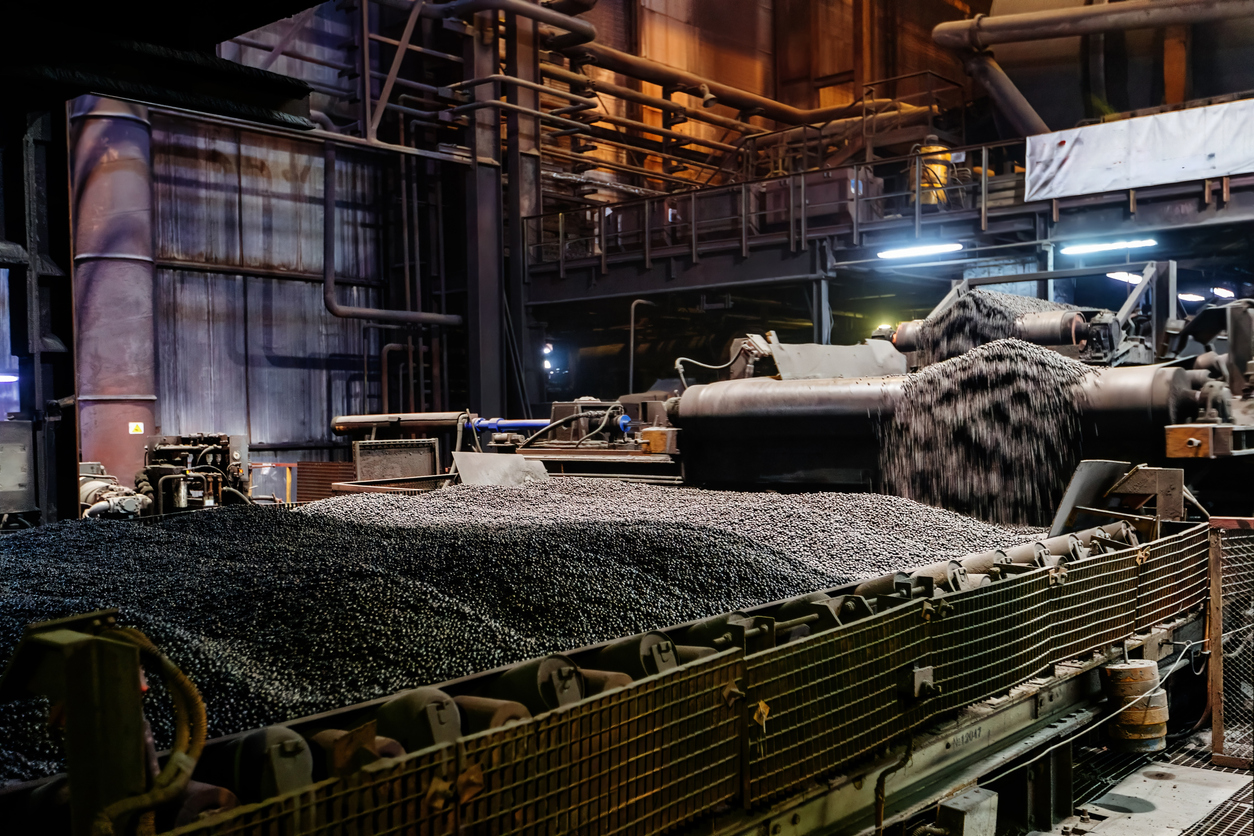
Industrial production line of Iron ore pellets in metallurgical factory
Different routes concentrate costs in different places:
Because energy prices, feedstock availability, and carbon policies vary widely by region, outcomes differ by site and market (Rootzén & Johnsson, 2016).
Electricity use provides a clear view of operational sensitivity for EAF-based routes:
Hydrogen DRI–EAF is widely regarded as the most future-proof option for new, ore-based primary steel capacity aiming at near-zero emissions. It replaces carbon in the iron-reduction chemistry with hydrogen, producing water rather than CO₂ (IEA, 2020; Vogl et al., 2018).
Low-carbon hydrogen is commonly produced by splitting water using electricity:
2H₂O → 2H₂ + O₂
(Vogl et al., 2018)
Inputs: water, electricity, electrolyser
Outputs: hydrogen (to the DRI plant) and oxygen (byproduct)
Hydrogen removes oxygen from iron ore to produce metallic iron. The solid product is direct reduced iron (DRI). Steel is not produced at this stage (IEA, 2020).
A simplified reaction for hematite is:
Fe₂O₃ + 3H₂ → 2Fe + 3H₂O
(IEA, 2020; Vogl et al., 2018)
Key clarification:
The 2Fe represents metallic iron. In practice, this iron exits the reactor as DRI, a porous solid mainly composed of iron. The oxygen leaves the ore as water vapor, not CO₂.
DRI is melted and refined in an electric arc furnace. Chemistry is adjusted with controlled additions of carbon and alloying elements to meet steel grade specifications (IEA, 2020).
Inputs: DRI (often blended with scrap), electricity, fluxes, small carbon/alloy additions
Outputs: liquid steel, slag, off-gas and dust
______________________________________________________________________________________________________________
______________________________________________________________________________________________________________
Daehn, K. E., Cabrera Serrenho, A., & Allwood, J. M. (2017). How will copper contamination constrain future global steel recycling? Environmental Science & Technology, 51(11), 6599–6606. https://doi.org/10.1021/acs.est.7b00997
Fischedick, M., Marzinkowski, J., Winzer, P., & Weigel, M. (2014). Techno-economic evaluation of innovative steel production technologies. Journal of Cleaner Production, 84, 563–580. https://doi.org/10.1016/j.jclepro.2014.05.063
Hasanbeigi, A., Arens, M., & Price, L. (2014). Alternative emerging ironmaking technologies for energy-efficiency and CO₂ emissions reduction: A technical review. Renewable and Sustainable Energy Reviews, 33, 645–658. https://doi.org/10.1016/j.rser.2014.02.031
International Energy Agency. (2020). Iron and steel technology roadmap: Towards more sustainable steelmaking. IEA.
Mathieson, J. G. (2025). A feed-flexible blast furnace strategy to place the steel industry on an accelerated path toward net-zero CO₂ emissions. Journal of Sustainable Metallurgy.
Rootzén, J., & Johnsson, F. (2016). Managing the costs of CO₂ abatement in the steel industry. Energy Policy, 98, 459–469. https://doi.org/10.1016/j.enpol.2016.09.026
Vogl, V., Åhman, M., & Nilsson, L. J. (2018). Assessment of hydrogen direct reduction for fossil-free steelmaking. Journal of Cleaner Production, 203, 736–745. https://doi.org/10.1016/j.jclepro.2018.08.279
Mathieson, J. G. (2025). A feed-flexible blast furnace strategy to place the steel industry on an accelerated path toward net-zero CO₂ emissions. Journal of Sustainable Metallurgy.
Rootzén, J., & Johnsson, F. (2016). Managing the costs of CO₂ abatement in the steel industry. Energy Policy, 98, 459–469. https://doi.org/10.1016/j.enpol.2016.09.026
Vale. (2021, September 9). Vale announces “green briquette” capable of reducing CO₂ emissions of steelmaking clients by up to 10% [Press release].
Vogl, V., Åhman, M., & Nilsson, L. J. (2018). Assessment of hydrogen direct reduction for fossil-free steelmaking. Journal of Cleaner Production, 203, 736–745. https://doi.org/10.1016/j.jclepro.2018.08.279